
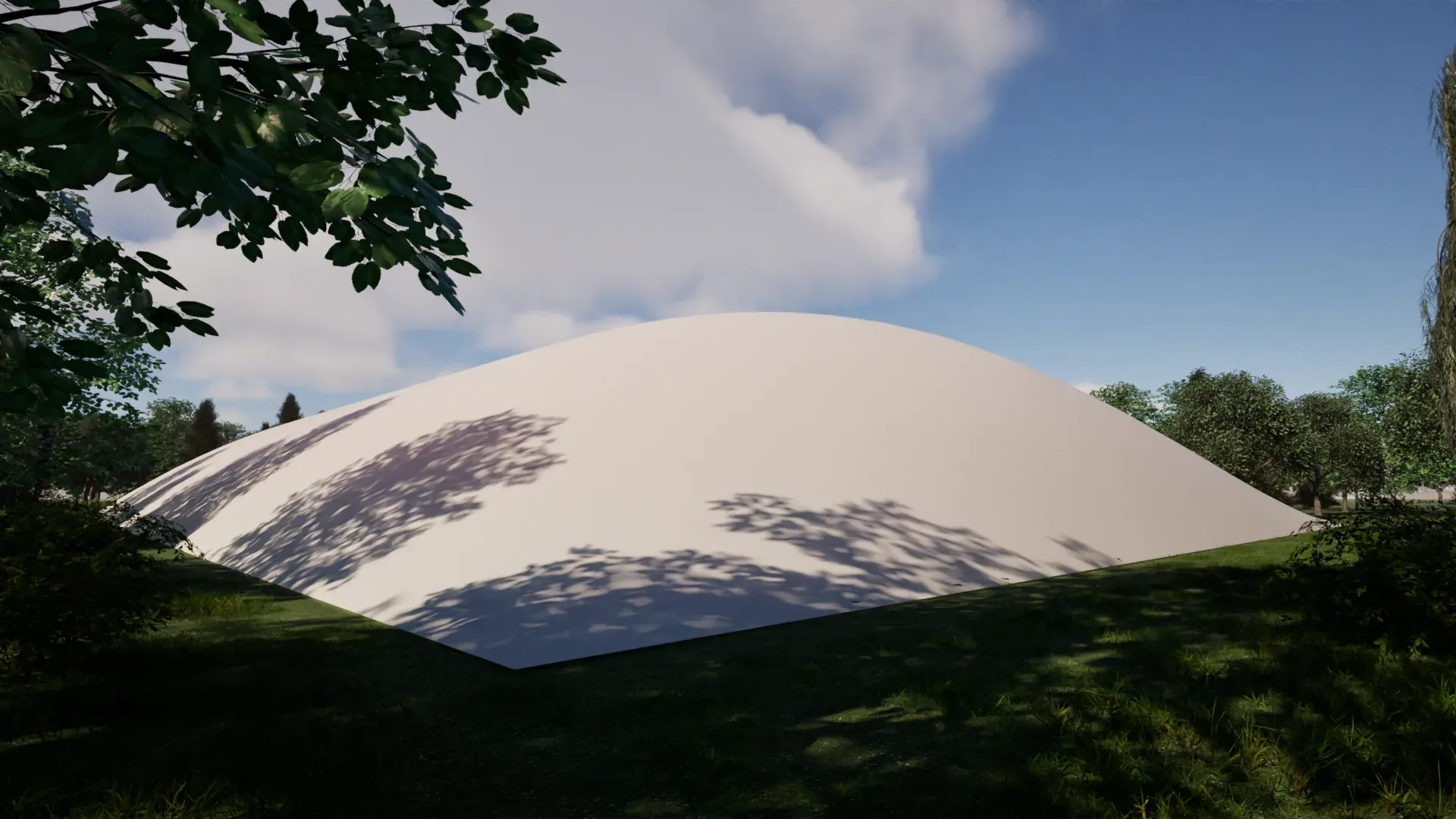
Air-supported dome vs traditional tent hall — which one to choose?
You are facing a challenge: you need to quickly and effectively roof over a sports pitch, expand warehouse space or create a temporary production facility. You know that traditional masonry construction is a long and complex road. Two lightweight technologies catch your attention: air-supported domes and tent halls. Both offer fast installation and flexibility, but their DNA is completely different. This is not just a choice between a “dome” and a “tent”. It is a strategic engineering decision that will affect the functionality, safety and operating costs of your facility for years.
Choosing the right technology requires understanding how each behaves under load, what energy demands it has and how it fits into the legal framework. This guide will help you analyse the key technical parameters of both solutions. Instead of generalities, you will get specific information that lets you make an informed decision tailored exactly to the specifics of your project.
Air-supported structure: how positive pressure works for you
Imagine a structure that does not need a heavy steel or aluminium frame. Its form and stability are provided entirely by controlled positive air pressure, maintained at just 250–350 Pa (Pascal). That is the operating principle of an air-supported dome. An integrated blower system keeps the pressure constant, guaranteeing the integrity of the structure regardless of external conditions. The absence of internal columns or trusses is a fundamental advantage, giving you a fully open, unobstructed usable space.
The key to functionality is the envelope — specifically a system of two membranes made of advanced PVC material (often type III or IV). Between them an insulating air cushion is created, fulfilling two key functions. First, it dramatically limits heat loss by eliminating thermal bridges. Second, it effectively prevents the condensation of water vapour on the inner surface of the roof, which is the bane of many sports facilities. The whole installation must be supported by reliable backup systems: a UPS and a generator that, in the event of a power failure, immediately take over the blower load and ensure full structural safety.
Traditional tent hall: solid frame and modular flexibility
In a traditional tent hall, the entire load-bearing duty is taken on by the frame. It is built from system aluminium profiles or, for larger spans and demanding requirements, hot-dip galvanised steel structures. The tent hall covers are tensioned over this frame, typically from a single layer of robust PVC tarpaulin. This modular construction is a major design advantage — it allows precise adaptation of the building to the shape of the plot and seamless future expansion.
Unlike air-supported domes, frame-based structures do not require constant power to maintain their shape, which translates into a different energy consumption profile. However, their design and operation bring different challenges. A flat or two-pitch roof must be carefully calculated for snow and wind loads in the relevant climate zone, in line with EN 1991. In practice this means the operator has to monitor snow depth and remove snow to prevent overloading. From our experience at Abastran, the key here is not only solid execution, but also the operator’s awareness of their operational responsibilities.
Key technical differences: what you need to consider
Before making a decision, line up the fundamental differences in how the two systems work. They will determine which technology better meets your operational and design needs.
-
Load-bearing mechanism: In an air-supported dome, positive pressure is the structural element. In a tent hall, it is a physical frame (aluminium or steel). This translates directly into the type of foundations required, the speed of installation and the adaptability of the interior.
-
Thermal insulation: A dual-membrane air dome offers integrated, high-performance insulation thanks to the air cushion. A tent hall typically uses a single tarpaulin with low insulation value. To achieve comparable thermal comfort, you have to invest in sandwich-panel walls and roof, which changes the character and budget of the entire project.
-
Snow load behaviour: This is one of the most important differences. The streamlined shape of an air dome actively prevents snow accumulation — snow simply slides off the envelope. A tent hall passively transfers snow loads to the frame, which requires regular monitoring and intervention from you.
-
Energy requirements: The “dome” needs constant power for the blowers. The “tent” uses energy mainly for heating and lighting. You need to analyse which energy consumption model will be more optimal for you in the long term.
Application scenarios: which technology meets your needs?
The choice depends on the purpose of the building. Each technology has areas where it shines and areas where its use would be inefficient.
Air-supported dome — ideal for sports and year-round facilities
If you are planning to roof tennis courts, a football pitch or an ice rink, an air dome is the natural choice. Why? Above all because there are no internal supports, which gives you full freedom of play. Excellent insulation and acoustics create comfortable conditions for athletes year-round. On top of that, its high resistance to snow loading eliminates the risk of winter shutdowns and the associated snow removal costs. This is a solution built for uninterrupted operation.
Tent hall — irreplaceable in logistics and industry
Need a warehouse or a light production facility? Here the frame-based structure has the edge. Its key advantage is the ability to mount overhead cranes, suspended installations or ventilation systems directly to the supporting structure. This allows the construction of high-rack storage and adaptation of the space to specific technological processes. Modularity also allows easy future warehouse expansion, which is crucial for growing companies.
Operational efficiency and life-cycle cost
Initial investment cost is only part of the equation. The true efficiency of a project is revealed in the long-term perspective, taking into account operating and maintenance costs. For an air-supported dome, the constant cost is energy for the blowers — but you gain lower heating bills thanks to better insulation. In a tent hall you do not have that constant cost, but you have to factor in higher heating costs (in the tarpaulin version) and potential snow removal costs.
The durability of materials is equally important. Modern tensile membrane structures made of PVC used in air-supported domes, protected by UV-resistant layers, retain their properties for 15–20 years. The standard tarpaulin in a tent hall may need replacement somewhat earlier, depending on operational intensity and weather conditions. When planning your project, you have to factor these life cycles into your budget.
Legal and formal aspects: notification or full building permit?
Before starting any work, you need to verify two fundamental issues: the local zoning plan and the provisions of the Building Act. The zoning plan can specify the permitted height, colour palette or even the type of roof, which can favour one of the technologies.
The Building Act allows the construction of temporary structures for a period of up to 180 days based on a simplified notification procedure. Both technologies fit this option perfectly. If, however, you plan to use the hall for longer, you will need to obtain a full building permit. At Abastran we always emphasise that the key to a smooth procedure is complete documentation, including a structural design with calculations for your wind and snow zone and fire-rating certificates for the envelope (e.g. class B-s2,d0). This is not just a formality — it is the guarantee of safety for your investment and its users.