
How to choose the right roofing structure for sports facilities?
Standing in front of a roofing decision for your sports facility? It is one of the most important calls you will make. A well-chosen roof is much more than just protection from rain or sun. It is your guarantee that the venue will be functional, safe and comfortable for users over many years. The market today offers a really broad range of options — from traditional steel structures, through elegant glulam, all the way to ultra-modern lightweight tensile membrane canopies and practical air-supported domes. Each of these solutions has its specific advantages, but also some limitations.
What types of roofing structures are available?
Before making a decision, it is worth getting to know the main types of roof structures used on sports facilities. They differ in material, technology, appearance and of course price. Understanding those differences is the first step to choosing the solution that will be the perfect match for your needs.
We start with the classic structures that have proven themselves over decades: steel, aluminium and timber. Each of those offers solidity and durability. Alongside them, increasingly popular innovative systems for lightweight roofs are appearing — tensile membranes and air-supported domes — opening up entirely new possibilities in shape, build speed and energy efficiency. Tent halls and prefabricated systems also deserve a mention as great options for temporary projects or when fast installation is the priority.
A solid base: steel, aluminium and timber structures
Steel structures are a frequent choice for large facilities such as stadiums or event halls. Their strength lies in exceptional durability. They can roof huge areas without a dense forest of internal columns, which gives a lot of freedom in laying out the interior. Steel also gives architects creative room to manoeuvre, enabling both simple and very sophisticated roof shapes. Remember, however, that steel needs corrosion protection and that its weight imposes specific requirements on the foundations.
The lighter alternative is aluminium. Its main advantage is natural rust resistance, which removes the need for additional protection and reduces maintenance costs. The lower weight of aluminium profiles makes installation faster and easier. It is a particularly good choice for humid environments, such as swimming pools or ice rinks. However, aluminium has some limitations when it comes to extreme spans, and the material itself can be more expensive than steel.
Glulam (glued laminated timber) brings an unmistakable warmth and visual identity to sports facilities. It is valued for its natural look, good acoustic properties and ecological character. Glulam structures allow for striking arches and frames, ideal for sports halls, riding arenas and tennis courts. Bear in mind, however, that timber requires proper moisture and fire protection, and its capabilities for very large spans are more limited than steel.
Modern lightness: tensile membrane and air-supported structures
Tensile membrane canopies are a real revolution in architecture. They use special, durable fabrics (PVC or PTFE) tensioned over a lightweight supporting structure. Their biggest strength? Exceptional light weight and the ability to create almost any flowing form. Membranes transmit daylight beautifully, which lets you save on artificial lighting, and special coatings make them durable and self-cleaning. It is an ideal solution for stadiums, amphitheatres and tennis courts, giving the facility a modern character. Bear in mind that designing and installing such structures requires specialist expertise — at Abastran we have specialised for years in delivering even the most complex tensile membrane and ETFE structures.
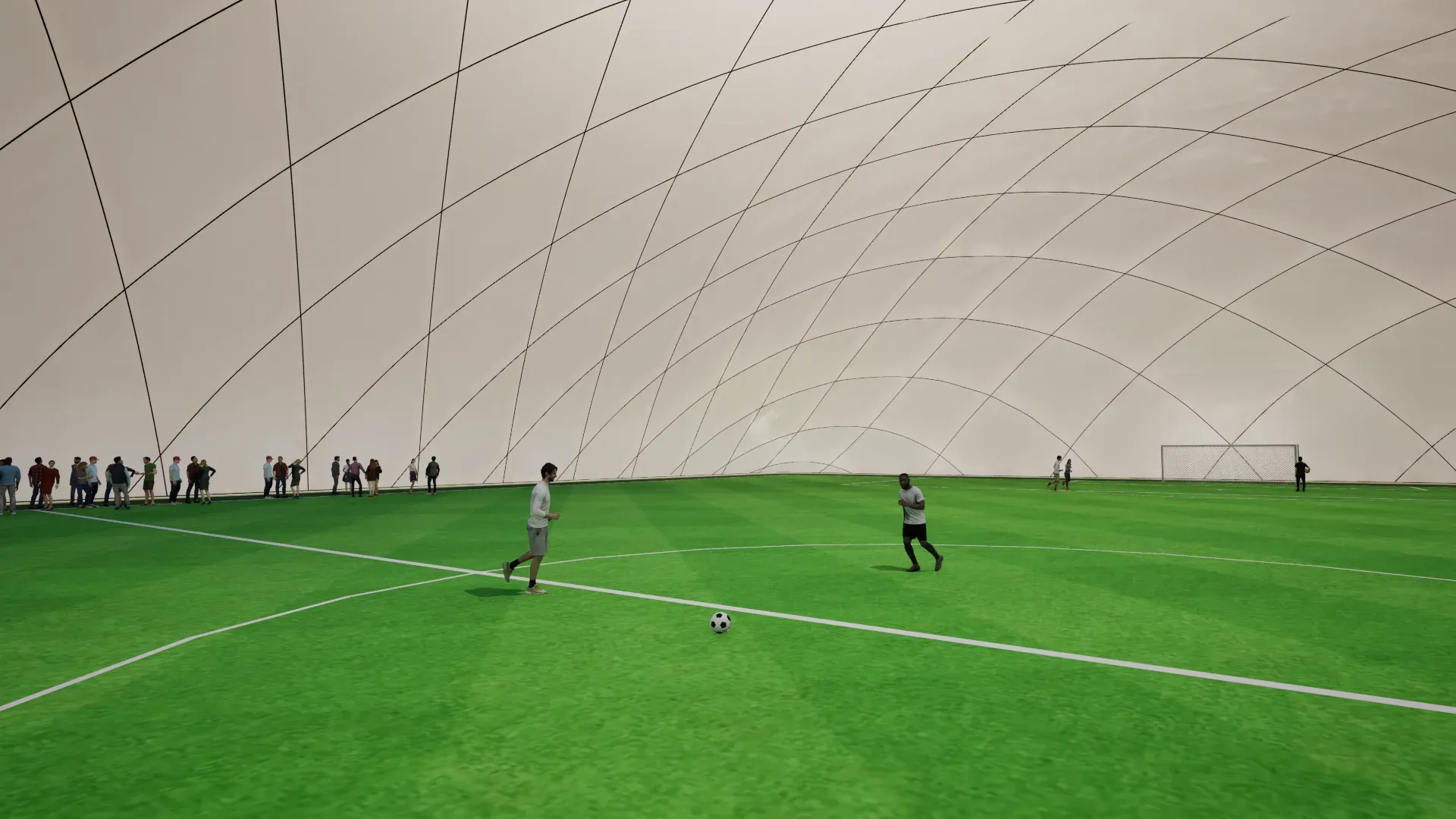
Air-supported structures, the popular “domes”, work on a different principle. The envelope is held up by positive air pressure inside the building. This is a very cost-effective solution and remarkably fast to install. It works very well for seasonal or year-round covers over pitches, courts or ice rinks. The main advantage is the ability to set up — and equally fast take down — the entire structure. You do, however, need to factor in the energy cost of maintaining the positive pressure and some operational limitations, particularly in strong wind.
Flexible solutions: tent halls and prefabricated buildings
Tent halls, typically based on a steel or aluminium frame covered with PVC tarpaulin, are a great option for temporary or seasonal facilities. They work well as covers over training pitches, as warehouses, or as event spaces. Their main strengths are fast installation and removal, relatively low cost and ease of expansion. Modern tent halls can be used year-round, but their service life is typically shorter than that of permanent structures.
Prefabrication is a method based on producing finished structural elements (concrete, steel) in a factory and assembling them on the construction site. This significantly shortens the project schedule and ensures high, repeatable quality. Prefabricated elements are used in roof structures as well as grandstands and walls. The approach is particularly attractive for standardised hall projects, but it can limit the freedom to shape unusual architectural forms.
Key criteria for choosing a roofing structure
Choosing a specific roofing technology is not an easy task. There is no single ideal solution for every project. To make the best decision for your facility, you need to analyse a few key factors carefully. What is most important to you? What are the specific needs of your investment?
Think about the function of the building, the budget and the timeline. Take local weather and ground conditions into account. Don’t forget about building regulations, safety standards and any sport federation requirements. A holistic look at all these aspects is what lets you choose a structure that will be a bullseye: safe, durable and economical.
What will the facility be used for?
The fundamental question is: what role will your sports facility play? A football stadium roof has different requirements than a basketball hall, and an indoor pool or tennis court is something else again. Size, required height, daylight access, acoustics, integration with ventilation — all of these affect the choice of material and technology. For example:
- Large stadiums often require long clear spans without internal supports, which favours steel or tensile membrane structures.
- Swimming pools make moisture and corrosion resistance critical, which is why aluminium or specially protected timber works well.
- Indoor team sports halls may need good acoustics and adequate height, both of which can be achieved with glulam or steel.
Remember the specifics of each sport. Some require very stable conditions, others special lighting. If you are planning a multi-purpose facility, the roof structure has to be versatile enough to handle different needs — for example by allowing heavy equipment to be suspended from the structure.
What is your budget and schedule?
Cost and timeline are often the deciding factors. Different technologies come with different material costs, installation costs and required build times. Steel structures and timber may be more expensive at the start but offer high durability. Air-supported and tent hall structures, on the other hand, are cheaper and faster to build, which is a major advantage when budget is tight or you need to put the facility into use quickly.
Remember, though, that cost is not just construction. Operating expenses are equally important: maintenance, repairs, heating and lighting. Lightweight membranes can lower electricity bills thanks to natural daylight transmission. Good insulating materials such as timber will reduce heating costs. Looking at the long term, a more expensive solution at the start can prove more economical over years of use.
Where will the facility be built and what is the weather like?
The location of your investment matters enormously. You need to take into account the local climate, especially snow and wind loading. In areas with heavy snowfall, the roof has to be strong enough to support its weight. Where strong winds prevail, structural stability is critical. These factors can affect the choice of material (e.g. heavy-duty steel) or roof shape (e.g. streamlined membrane forms).
Don’t forget about ground conditions either. Heavy structures require solid foundations, which on poor ground can significantly raise the project cost. In such cases, lightweight aluminium, membrane or air-supported structures can be a better choice. Pay attention to the surroundings too — proximity to other buildings or trees can affect wind loading.
What are the regulations and safety standards?
Every sports facility must meet legally defined requirements. The roof design must comply with standards covering loads (snow, wind), fire safety and general structural safety. Whichever technology you choose, the design must be done by qualified engineers and the entire build properly supervised and documented.
If you plan to host official competitions, you also have to meet the requirements of specific sport federations (FIFA, FIVB, etc.). These can cover pitch dimensions, hall height, lighting or even colour. Check those guidelines at the start to avoid problems with future facility homologation. If you are facing the challenge of choosing the best solution for your facility, get in touch with us — the Abastran experts will be happy to answer your questions and help you select the optimal technology.